Electronic Piano Vibration Solutions | Physically Stopping Midnight 'Clacking' from Reaching Neig...
'I'm wearing headphones, but my neighbor complained.' The cause is not volume, but 'Structure-Borne Noise' from keystrokes and pedals traveling through the building. We reveal secrets for vibration insulation.
Many assume that an electronic piano is “Silent” if the volume is turned down and headphones are used. However, there is a major trap in soundproofing here.
The reality of “Sound complaints while using headphones” is not sound traveling through the air, but the impact of fingertips hitting keys traveling through the piano body and violently vibrating the floor—this is Structure-Borne Noise (Vibration).
In this article, we explain the strategy to physically block the “Clacking” impact noise from reaching downstairs.
Conclusion : “Silent” Complaints are Actually Floor Impact Vibrations
During performance, the kinetic energy of a key hitting the bottom travels easily even through high-performance concrete apartment floors (slabs).
- The Reality of Impact : While it lacks the rich resonance of an acoustic piano, the physical mechanical noise of the action is perceived by downstairs neighbors as an irritating, intermittent “knocking on the ceiling.”
- Transmission via Solids : Concrete is dense and excellent at blocking air sound, but it is extremely efficient at transmitting impact waves (vibrations).
Physics of Keystrokes : How Impact Travels Through Concrete
Without understanding why sound leaks despite thick concrete floors, a correct solution is impossible.
- Impulse Noise : Keystroke and pedal noises are “Impulse (Impact)” sounds that rise instantaneously. These trigger more psychological irritation than continuous music and are hard to ignore once noticed.
- Resonant Amplification : If the piano is flush against a wall, not only the floor but the entire wall acts like a speaker cone, radiating vibration throughout the building.
Multi-Layer Vibration Bases : Damping via Impedance Mismatching
The most effective way to stop vibration is “Decoupling the Piano from the Floor.”
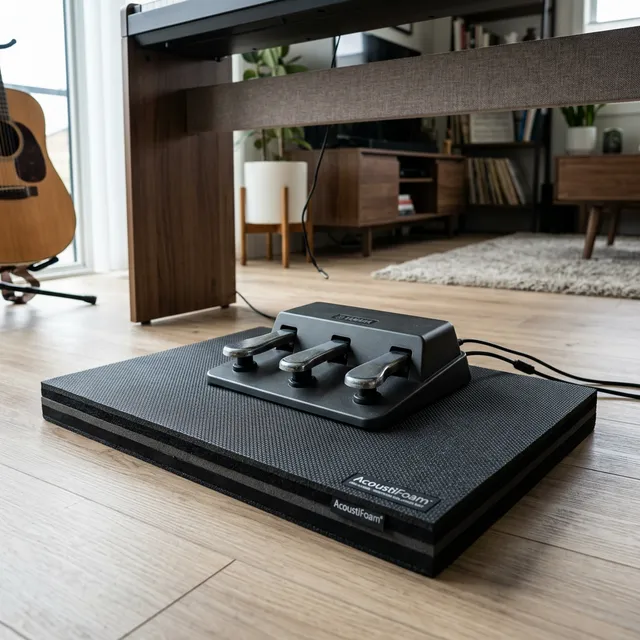
- The Multi-Layer Theory : A single rubber mat is insufficient. By layering rubber (spring layer), plywood (load distribution layer), and carpet (absorber layer), you intentionally disrupt the “Acoustic Impedance” at each boundary, reflecting and decaying energy.
- Recommended Placement : Do not just place pads under the feet. Cover the entire footprint of the piano with a vibration base to distribute weight and suppress slab resonance.
The Pedal Blind Spot : The Effectiveness of ‘Noise Eaters’
Even more intense than keystrokes is the “Thud” when depressed the damper pedal.
- The Value of Specialized Gear : Dedicated vibration items like Roland’s “Noise Eater” series use unique hemispherical rubber structures to efficiently convert impact into “Heat Energy.” In wooden or lightweight steel apartments, this level of mechanical insulation is mandatory for midnight play.
- Limits of DIY : Cheap rubber from hardware stores can be crushed by the piano’s weight, losing its spring function. Selecting materials with hardness suited to the load is essential.
Conclusion : You Cannot Coexist with Neighbors Without Decoupling
Electronic pianos are not “Instruments that make no sound” ; they are simply “Instruments where sound-related trouble is harder to see.”
- Always insert a multi-layer vibration base between the piano and the floor.
- Keep the unit at least 10cm from walls to block resonance paths.
- If pedal noise is loud, use dedicated insulators.
By not sparing this “Investment in your Feet,” you gain the privilege of being free from time constraints and immersing yourself in music to your heart’s content.
Related Articles :