Acoustic Piano Soundproofing Handbook: Upright/Grand Isolation & Floor Load Mechanics
Can you actually play a 100dB acoustic piano in an apartment? An engineering dive into piano acoustics. Required D-ratings for 24-hour rehearsal, structural load limits (1,000kg+ builds), and the 'Floating Floor' protocol mandatory for stopping mechanical vibration from pedals and hammers.
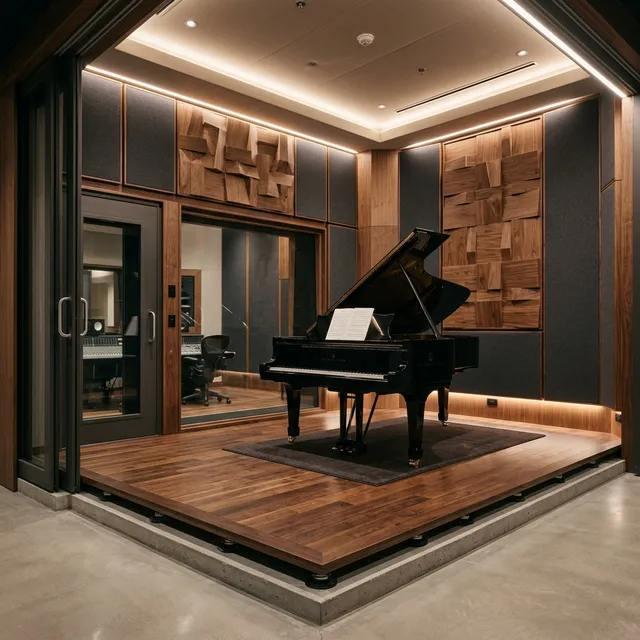
Bottom Line: The acoustic piano is arguably the ‘Final Boss’ of residential soundproofing.
A piano’s volume reaches 90dB-100dB, and unlike most instruments, it generates massive “Structural Vibration” (Structure-borne noise) directly through its legs into the building’s skeleton. Standard acoustic foam on walls is physically incapable of stopping this. Success depends on two variables: Mass-Loaded Isolation (Dr-40+) and High-Capacity Structural Reinforcement.
This technical briefing outlines the protocol for safely integrating an acoustic piano into a modern residential space.
1. Defining Your Target Isolation (D-Value)
Your requirements depend on your intended playing hours and environment.
| Piano Type | Volume Dynamics | Recommended (Daytime) | Recommended (24-Hour) |
|---|---|---|---|
| Upright | Directional (Back-facing) | Dr-35 to Dr-40 | Dr-45+ |
| Grand Piano | OMNI-directional / Massive LF | Dr-40+ | Dr-50+ |
- Dr-35 (D-35): Sufficient for daytime practice in most suburban settings.
- Dr-40 (D-40): The industry standard for urban apartments; allows practice until ~10 PM.
- Dr-50 (D-50): Professional grade. Delivers silence even for 2 AM sessions in high-density areas.
2. Spatial Logic: Why “Fit-to-Size” is a Failure
Selecting a booth based purely on the dimensions of the piano leads to “Acoustic Saturation”—deadening your ears and preventing proper maintenance.
- Upright Pianos: 2.0-Tatami (3.3㎡) minimum.
- You need a 10-15cm air gap behind the soundboard for tone development and tuning access.
- Grand Pianos (C3-Class): 3.5-Tatami (5.8㎡) minimum.
- While it “fits” in 3.0-Tatami, you lose the seating clearance and the tuner’s access to the action, making maintenance nearly impossible.
3. The Structural Barrier: Floor Load & Weights
The total weight of a piano plus a soundproof booth is extreme.
- Total Load: Piano (350kg) + Soundproof Unit (500kg+) = 850kg to 1,200kg (1.2 Tons).
- Building Codes: Standard Japanese residential floors are rated for ~180kg/㎡.
A pro-grade unit in a wooden residence requires specialized structural reinforcement (additional joists or support pillars). Installing without these can lead to floor sagging, jammed doors, or long-term structural fatigue.
4. The “Floating Floor” Requirement
Mechanical noise—vibrations from the hammers hitting strings and pedals hitting the floor—is your biggest risk for neighbor complaints. Premium units like Yamaha’s “Abitex” or Kawai’s “Nasar” succeed because they utilize a True Floating Floor System. The entire room is decoupled from the building’s floor using high-density rubber damping. If you are building a DIY solution or using lightweight booths, this mechanism is often missing or insufficient.
5. Summary: High-Spec Isolation is a Long-Term Asset
Investing in an acoustic piano booth is a multi-dimensional ROI:
- Tonal Preservation: Better room acoustics lead to better ear training.
- Psychological Freedom: The ability to play anytime without social friction.
- Asset Retention: High-quality modular units retain 60-70% of their value in the used market.
For a lifelong instrument like the acoustic piano, opting for a Dr-40 or higher specification is the only logical engineering choice.