Why a 1.5 Tatami Soundproof Room is the Most Popular | Key Standards for Piano and Wind Instrumen...
'How much space is needed to buy a soundproof room?' The most common answer is 1.5 tatami. We will thoroughly explain the minimum size that fits an upright piano, and the versatile space that allows wind and string instruments to be used comfortably, as well as prices and actual usage feelings.
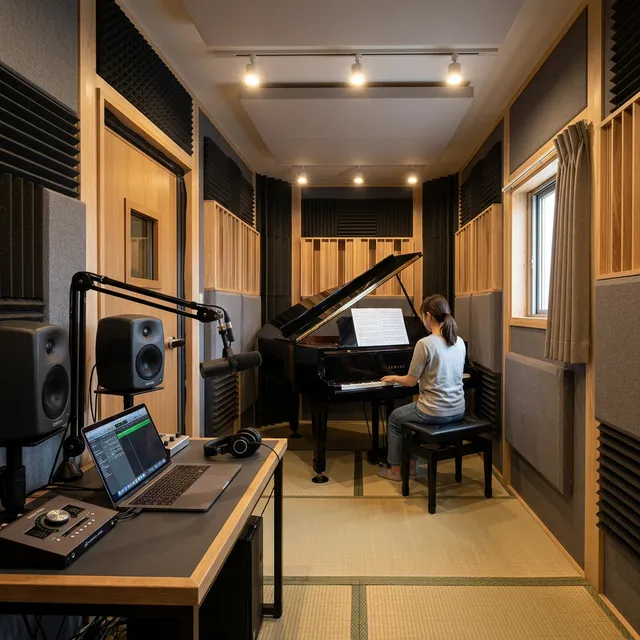
“If you’re unsure, go with 1.5 tatami (about one tsubo).”
This is the standard advice given by staff at music stores and soundproof room manufacturers. In the soundproof room market, 1.5 tatami is the best-selling ‘Golden Size’. If it’s narrower than this, there will be more instruments that cannot be installed, and if it’s wider, the hurdles of price and installation location will rise sharply.
In this article, we explain why 1.5 tatami is so supported, along with tips for choosing one.
”What You Can Do” in 1.5 Tatami: Covers Almost All Instrument Performances
A space of 1.5 tatami (approx. 2.7㎡) is “necessary and sufficient” for one person to spend a long time with an instrument.
- Installing an Upright Piano: 1.5 tatami is the minimum size that can secure the upright piano body and space to pull back the chair behind it.
- Wind Instruments (Saxophone, Trumpet, etc.): Even if you play standing up, you won’t hit the wall with your bell, and there’s enough room to set up a music stand.
- String Instruments (Cello, Double Bass, etc.): Even with string instruments that use large bows, you can hold them comfortably without bumping your elbows.
- Duo (Sitting Case): A duo of about two violins is possible, although it will be a little cramped.
Realistically Imagine the “Sense of Size” of 1.5 Tatami
1.5 tatami is “about the size of three half-tatami closets” or “about the size of one single futon with a little space next to it”.
- Warning about External Dimensions: Even if the interior is 1.5 tatami, because of the thickness of the walls, you will actually need 2.5 to 3 tatami mats worth of space when placing it in a room.
- Height: Many models have “Standard Height” and “High Ceiling”, but for instruments played standing or for tall people, you will feel a sense of pressure unless you choose a “High Ceiling”.
Yamaha vs Kawai: Comparison of Representative 1.5 Tatami Models
| Item | Yamaha Avitecs (Cefine NS) | Kawai Nasal (LKS Series) |
|---|---|---|
| Reference Price | From approx. $12,000 | From approx. $10,000 |
| Features | Bright and clear sound resonance. | Abundant variations of sound insulation panels. |
| Strengths | Easy to assemble/disassemble and high used value. | Excellent cost performance and high degree of freedom in ordering. |
Summary: 1.5 Tatami is an “Investment” to Avoid Regret
Compared to the 1 tatami size, 1.5 tatami is about $2,000 more expensive. However, once you start using it, that “slight 0.5 tatami difference” makes a dramatic difference in practice motivation and physical fatigue.
Especially if you want to make piano a life-long hobby, 1.5 tatami is a line you absolutely should not compromise on.