0.8 to 1 Tatami Soundproof Room Guide | Optimal Solution for Streaming, Telework, and Studio Living
For those who 'want to use it for streaming or telework' or 'want to keep it to a minimum because the room is narrow'. We will explain the merits and demerits of compact soundproof rooms of 0.8 to 1 tatami, and layout examples of desks and microphones.
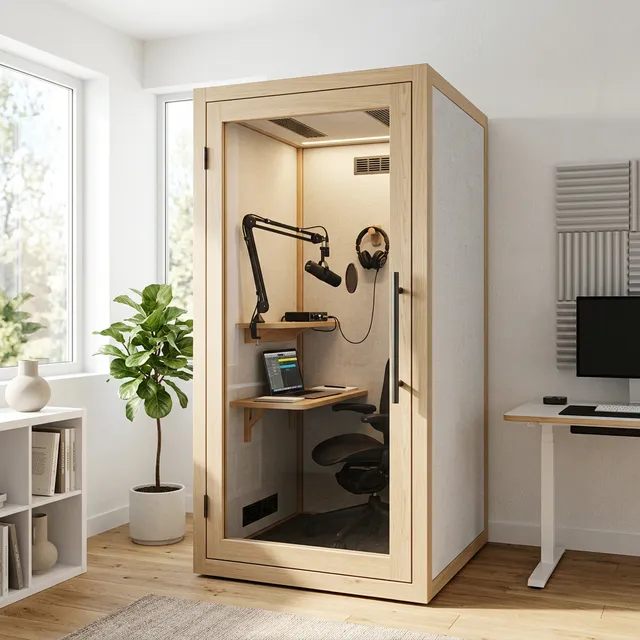
“The room is narrow, but I want a quiet environment” “I want to create my own booth for video streaming or telework”
The choice most selected by such people now is the compact soundproof room of 0.8 to 1 tatami size. This size used to be called “narrow and hard to use”, but with the evolution of technology and changes in needs, it has become a very practical choice.
In this article, we will provide guidelines for making the most of the minimum size soundproof room.
”What You Can and Can’t Do” in a 0.8 to 1 Tatami Soundproof Room
First, let’s grasp the reality of this sense of size.
What You Can Do
- Video Streaming/Game Commentating: This is perfectly possible with a desk setup including a microphone and one monitor.
- Telework/Web Conferences: You get a concentrated space where no one bothers you.
- Vocal Recording: There’s plenty of room in 1 tatami if you’re just standing and singing.
- Violin/Flute Performance: It’s possible to perform while sitting or by adjusting your posture.
What You Can’t Do
- Install an Upright Piano: It does not fit physically.
- Use with Multiple People: It is for single person use only.
- Big Actions: It is difficult to swing a guitar or move around vigorously.
Two Choices for the Minimum Size: Simple Type vs Unit Type
When considering the 0.8 tatami class, there are the following two routes.
1. Simple Soundproof Room (Danbotchi, OTODASU, etc.)
- Price: Around $600 to $2,000.
- Merit: Cheap and light. Easy to assemble and disassemble yourself.
- Who it’s for: Streamers who want to “reduce voice leakage to the next room a little” or “suppress reverberation”.
2. Unit Soundproof Room (Yamaha Avitecs, Kawai Nasal, etc.)
- Price: Around $8,000 to $12,000.
- Merit: Authentic sound insulation performance (Dr-35 to 40). Many models allow for air conditioning installation.
- Who it’s for: Those who want to “sing in the middle of the night in an apartment” or “perfectly shut out outside noise”.
Use Narrow Space Widely! Layout Tips
In a limited space of 1 tatami, a 1cm placement error leads to a feeling of pressure.
- Desks should be “Width” rather than “Depth” If there is too much depth, there will be no room to pull back the chair. It’s a rule to choose a desk with a depth of 45 to 50 cm and float the space with a monitor arm.
- Effective Use of Walls Don’t put things on the floor; use wall-mounted storage that also serves as acoustic panels.
- Lighting and Color Use By choosing bright lighting and an interior (or acoustic material color) based on white, you can alleviate visual claustrophobia.
Summary: 0.8 Tatami/1 Tatami will be the “Best Work Desk”
If you throw away the stereotype that “soundproof room = musical instrument”, this minimum size becomes the strongest concentration booth in modern times.
Especially for those living in a studio apartment of around 6 tatami, the benefit of being able to physically separate the living space from the working space is immeasurable.