
When considering a soundproof room in Japan, the biggest barrier is often the “Opaque Total Cost.”
The catalog price is just the tip of the iceberg. Delivery, assembly, air conditioning, and electrical work—these hidden variables determine the final “On-Road Price.” However, in 2026, international buyers and residents in Japan have a unique advantage: The Currency Bridge. With the Yen at historic lows, the absolute cost of professional Japanese acoustics has never been more attractive.
1. 2026 Price Mapping: From Entry to Pro#
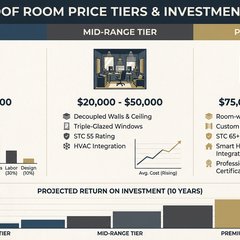
In Japan, the quality of “Silence” you receive is strictly tied to your investment. Here is the current market breakdown:
| Budget Range (JPY) | Category | Typical Use Case | Performance Level |
|---|---|---|---|
| ¥100k 〜 ¥250k | Entry Booths | OTODASU, Danbocchi | Reduces shouting to “speaking” volume. Perfect for streamers. |
| ¥500k 〜 ¥1.0M | Semi-Pro Units | Used Cefine NS, DIY kits | Blocks normal conversation / Mid-volume practice. |
| ¥1.0M 〜 ¥2.0M | Standard Units | Yamaha, Kawai Dr-40 | Pro-level. 24/7 streaming and piano practice. |
| ¥3.0M 〜 ¥6.0M | Custom Construction | Studio builds | Drum sets, commercial recording studios. |
The ¥200,000 Hack : For streamers on a budget, the 200k JPY class (approx. $1,300 USD) is a game-changer. These lightweight booths can be placed in standard Japanese apartments without floor reinforcement and are specifically engineered to kill the high-frequency peaks of “gaming screams,” keeping you safe from neighbor complaints.
2. The Global Advantage: Monitoring the Exchange Rate#
For those earning in USD, EUR, or GBP, Japanese soundproof rooms are currently on a “Global Sale.”
A 1.5 million JPY high-end Yamaha booth used to cost $15,000 USD a few years ago. Today, depending on the rate, that same unit might be secured for $9,500 to $10,500 USD. For international creators looking to set up a base in Japan or even ship components overseas, evaluating the “Real Cost” in your home currency can make a high-end Dr-40 unit significantly more affordable than a custom local build in your home country.
3. Hidden Costs: The “4 Pillars” of Budgeting#
A catalog price of 1.5 million JPY usually results in a final invoice of 1.8 to 2.0 million JPY. Plan for these four essentials:
- Shipping & Assembly (¥100k - ¥200k) : Professional installation is required. Fees increase for 2nd-floor installations or crane requirements.
- Air Conditioning (¥80k - ¥150k) : High-precision booths are airtight saunas. Specific AC installation by acoustic specialists is necessary to maintain soundproofing.
- Electrical & Network (¥30k - ¥50k) : Dedicated lines for PCs and lighting must be ran into the booth to avoid ground loop noise.
- Fire Safety (¥30k - ¥50k) : Per Japanese Fire Law, an independent smoke detector is mandatory for enclosed rooms.
4. ROI: Soundproof Rooms as a Liquid Asset#
Unlike custom renovations that disappear into the building’s value, unit-type booths from Yamaha and Kawai are highly liquid assets in Japan.
- High Resale Value : A well-maintained 1M JPY booth can often be sold for 30–50% of its price even after 5 years.
- Depreciation : For sole proprietors (Kojin Jigyo), these booths are depreciable assets over 15 years. When factoring in tax savings, the “Actual Monthly Cost” is often lower than your smartphone bill.
Conclusion: Invest in Permanence, Not a Placeholder#
While the 100k-200k JPY entry booths are fantastic for avoiding immediate trouble, they lack the acoustic “clarity” required for professional recording.
If you plan on making content your career, leverage the current Exchange Rate Advantage to secure a Dr-40 Standard Unit. It is an investment that protects your neighbors’ peace, enhances your production quality, and remains a valuable asset for a decade or more.
Related Articles :