
When building a DIY soundproof room, many people focus on the sound insulation of the walls and ceiling, but the physically highest risk lies at your ** “Feet (The Floor).” **
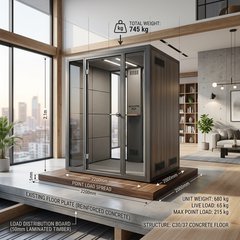
A soundproof room using generous amounts of gypsum board and sound insulation sheets can reach a total weight of 200–400kg even for a unit smaller than 1-tatami (1.5sqm), which easily exceeds residential design standards.
In this article, we reveal the design protocol for the ** “Weight Distribution Plate (Baseboard)” ** to protect the building’s safety and enhance soundproofing performance.
Conclusion : Baseboard Roles are “Structural Protection” and “Vibration Isolation”#
In a DIY soundproof room, placing equipment directly on the floor is strictly prohibited. The baseboard has two decisive roles.
- Surface Load Distribution : The residential floor load limit (180kg/sqm) defined by the Building Standards Act assumes that weight is applied evenly across the entire room. If you do not convert the “Point Load” of a soundproof room into a “Surface Load,” it will lead to floor sagging and fatigue of structural materials.
- Solid-Borne Noise Isolation : It serves as the starting point for a “Floating Floor Structure” that prevents instrument vibrations and walking sounds from traveling directly into the floor.
Material Selection : “Structural Plywood” is the Best for Surface Rigidity#
The baseboard requires sufficient thickness and ** “Bending Rigidity.” **
- Recommended Material : Structural Plywood (T-2 or higher) with a thickness of 12mm or more. Ideally, two layers (total 24mm) are preferred. While MDF is easy to process, it is weak against moisture and tends to sag under weight, making it insufficient as a baseboard foundation.
- Determining Size : Allow for a margin of about ** “50–100mm plus” ** compared to the external dimensions of the soundproof room. This ensures the edges can firmly catch and distribute the load.
Anti-Vibration Unit Placement : Theory for Stability and Isolation#
The placement of “Vibration Isolators” sandwiched between the plywood and the existing floor dictates soundproof performance.
- The Trap of Even Spacing : Load concentrates at the four corners (or where pillars are located). Place vibration rubber directly under the points where the primary weight is applied, not just in the center.
- Vibration Rubber Hardness : Rubber that is too soft will be completely crushed by the weight of the soundproof room, becoming a “Solid Bridge” that transmits vibration. Check specs like ** “Load Capacity 100kg/unit” ** and adjust the quantity to have a capacity of 1.2–1.5 times the total weight.
Multi-Layer Structure Recipe : Sandwich for Maximum Insulation#
Here is a baseboard layout example recommended by professionals that is feasible even for DIY (from bottom to top).
- Vibration Rubber Blocks (Isolation from the floor)
- Structural Plywood 12mm (Base for load distribution)
- Sound Insulation Sheet (Blocking high-frequency sound)
- Structural Plywood 12mm (Stabilizing the finish surface)
- Thick Tile Carpet (Indoor absorption and preventing cold feet)
This 5-layer structure minimizes floor damage while drastically reducing keystroke noise and footsteps reaching downstairs.
Summary : A Solid Foundation Decides the Lifespan of a DIY Room#
It is impossible to dismantle and redo the floor once the soundproof room is completed.
- Check the “Total Weight” (including gear and people) and compare it with the floor load capacity.
- Ensure sufficient rigidity based on 12mm+ structural plywood.
- Physically decouple from the existing floor using vibration isolators of appropriate hardness.
A strong weight distribution plate is not just a pedestal. It is a physical balancer to protect your “Precious Home” and your “Peaceful Relationship” with downstairs neighbors.
Related Articles :