
In apartment living across the globe—from Tokyo to New York—the most frequent cause of “neighbor wars” isn’t loud music. It is “Solid-Borne Sound” (Vibration).
The sound of a heavy heel hitting the floor, a chair dragging across the room, or a frustrated gamer slamming their desk travels directly through the building’s concrete or wooden frame. Unlike “Airborne Sound” (voices), vibrations act like a shockwave, vibrating the entire structure and echoing into rooms floors away.
Today, as an acoustic architect, I will introduce the “Japanese Secret” to solving this: High-density decoupling layers.
1. Why Standard Rugs Fail the Vibration Test#
Most people try to solve noise complaints by buying a thick, fluffy rug. While this helps absorb some high-frequency “clicks,” it fails to stop low-frequency impacts.
- Airborne Sound : Blocked by mass and absorbed by soft materials.
- Solid-Borne Sound : Requires Mechanical Decoupling. You must physically separate your lifestyle from the building’s structural frame.
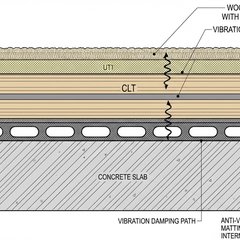
If the impact energy reaches the floorboards, the floor itself becomes a “speaker” for the neighbor below. To stop this, you need a multi-layered approach that creates a “floating floor” effect.
2. The Japanese Professional Standard: The 3-Layer Method#
Japan has some of the most advanced “DIY Soundproofing” materials in the world due to the high density of apartment living. You can find these specialized products on Amazon (look for brands like Sanko or Shizuyuka). Here is the best proposal for a “Silence-Protecting Floor.”
Layer 1: The Base Dampener (High-Density Rubber)#
The foundation should be a high-density mat, such as P-Mats (P防振マット) or high-grade bitumen/rubber sheets. These are heavy and dense, designed to stop the structural “ringing” of the floor.
Layer 2: The Distribution Plate (Rigidity)#
This is the “Pro Secret.” Instead of putting a carpet directly on rubber, place a thin layer of plywood or a specialized rigid acoustic board in between. This distributes the “point impact” (like a chair leg or a footstep) across the entire surface of the dampener underneath, maximizing its efficiency.
Layer 3: High-Performance Tile Carpets#
For the top layer, use Japanese “Shizuyuka Light” (静床ライト) tile carpets. Unlike regular rugs, these are weighted with a special backing that absorbs vibration and prevents the carpet from sliding, while the surface fibers absorb high-frequency impact noise.
3. Case Specific Solutions#
For Gamers: “Desk Slam” (Taipan) Prevention#
If you are a competitive gamer, the vibration from your keyboard or a “reactive desk slam” travels down the desk legs.
- The Fix : Attach Vibration Isolation Rubber pads to the feet of your desk. For maximum effect, apply a dampening sheet (like Legetolex) to the underside of the desk surface to “kill” the resonance of the wood itself.
For Remote Workers: The “Rolling Chair” Rumble#
Office chair casters are noise machines.
- The Fix : Switch your casters to soft urethane versions and place a high-density chair mat over your anti-vibration carpet. This prevents the “rumble” from entering the floor joists.
4. Where to Buy: The Best Proposal#
If you are struggling with complaints, don’t waste money on thin “soundproof rugs.” Look for the following on Amazon Japan (which offers global shipping on many items) or domestic equivalents specializing in “Acoustic Grade” mats:
- Anti-Vibration Underlay : Search for “P防振マット” or “Vibration Isolation Sheet.”
- Weighted Tile Carpets : Search for “静床ライト” (Shizuyuka Light). These are the gold standard for Japanese residents.
Conclusion: Decouple Your Life for Peace of Mind#
Solving vibration issues is about physics, not thick fabric. By decoulping your activities from the floor, you are essentially “floating” your room within the building.
Invest in high-density layers, distribute the weight, and stop the shock before it hits the concrete. It is the only way to ensure that your midnight gaming or early morning workouts don’t lead to an awkward conversation with your neighbor.
Related Articles :