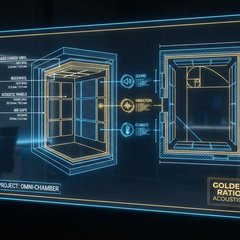
Bottom Line: The acoustic piano is arguably the ‘Final Boss’ of residential soundproofing.
A piano’s volume reaches 90dB-100dB, and unlike most instruments, it generates massive “Structural Vibration” (Structure-borne noise) directly through its legs into the building’s skeleton. Standard acoustic foam on walls is physically incapable of stopping this. Success depends on two variables: Mass-Loaded Isolation (Dr-40+) and High-Capacity Structural Reinforcement.
This technical briefing outlines the protocol for safely integrating an acoustic piano into a modern residential space.
1. Defining Your Target Isolation (D-Value)#
Your requirements depend on your intended playing hours and environment.
| Piano Type | Volume Dynamics | Recommended (Daytime) | Recommended (24-Hour) |
|---|---|---|---|
| Upright | Directional (Back-facing) | Dr-35 to Dr-40 | Dr-45+ |
| Grand Piano | OMNI-directional / Massive LF | Dr-40+ | Dr-50+ |
- Dr-35 (D-35): Sufficient for daytime practice in most suburban settings.
- Dr-40 (D-40): The industry standard for urban apartments; allows practice until ~10 PM.
- Dr-50 (D-50): Professional grade. Delivers silence even for 2 AM sessions in high-density areas.
2. Spatial Logic: Why “Fit-to-Size” is a Failure#
Selecting a booth based purely on the dimensions of the piano leads to “Acoustic Saturation”—deadening your ears and preventing proper maintenance.
- Upright Pianos: 2.0-Tatami (3.3㎡) minimum.
- You need a 10-15cm air gap behind the soundboard for tone development and tuning access.
- Grand Pianos (C3-Class): 3.5-Tatami (5.8㎡) minimum.
- While it “fits” in 3.0-Tatami, you lose the seating clearance and the tuner’s access to the action, making maintenance nearly impossible.
3. The Structural Barrier: Floor Load & Weights#
The total weight of a piano plus a soundproof booth is extreme.
- Total Load: Piano (350kg) + Soundproof Unit (500kg+) = 850kg to 1,200kg (1.2 Tons).
- Building Codes: Standard Japanese residential floors are rated for ~180kg/㎡.
A pro-grade unit in a wooden residence requires specialized structural reinforcement (additional joists or support pillars). Installing without these can lead to floor sagging, jammed doors, or long-term structural fatigue.
4. The “Floating Floor” Requirement#
Mechanical noise—vibrations from the hammers hitting strings and pedals hitting the floor—is your biggest risk for neighbor complaints. Premium units like Yamaha’s “Abitex” or Kawai’s “Nasar” succeed because they utilize a True Floating Floor System. The entire room is decoupled from the building’s floor using high-density rubber damping. If you are building a DIY solution or using lightweight booths, this mechanism is often missing or insufficient.
5. Summary: High-Spec Isolation is a Long-Term Asset#
Investing in an acoustic piano booth is a multi-dimensional ROI:
- Tonal Preservation: Better room acoustics lead to better ear training.
- Psychological Freedom: The ability to play anytime without social friction.
- Asset Retention: High-quality modular units retain 60-70% of their value in the used market.
For a lifelong instrument like the acoustic piano, opting for a Dr-40 or higher specification is the only logical engineering choice.