Soundproof Rental Selection for Streamers 2026 | Risks in 'Streaming-Friendly' Labels and D-Value...
Why is a simple 'Instrument Allowed' property insufficient for streamers? We explain the 2026 property selection points, how to decode D-values, and how to check climate systems that define your audio quality.
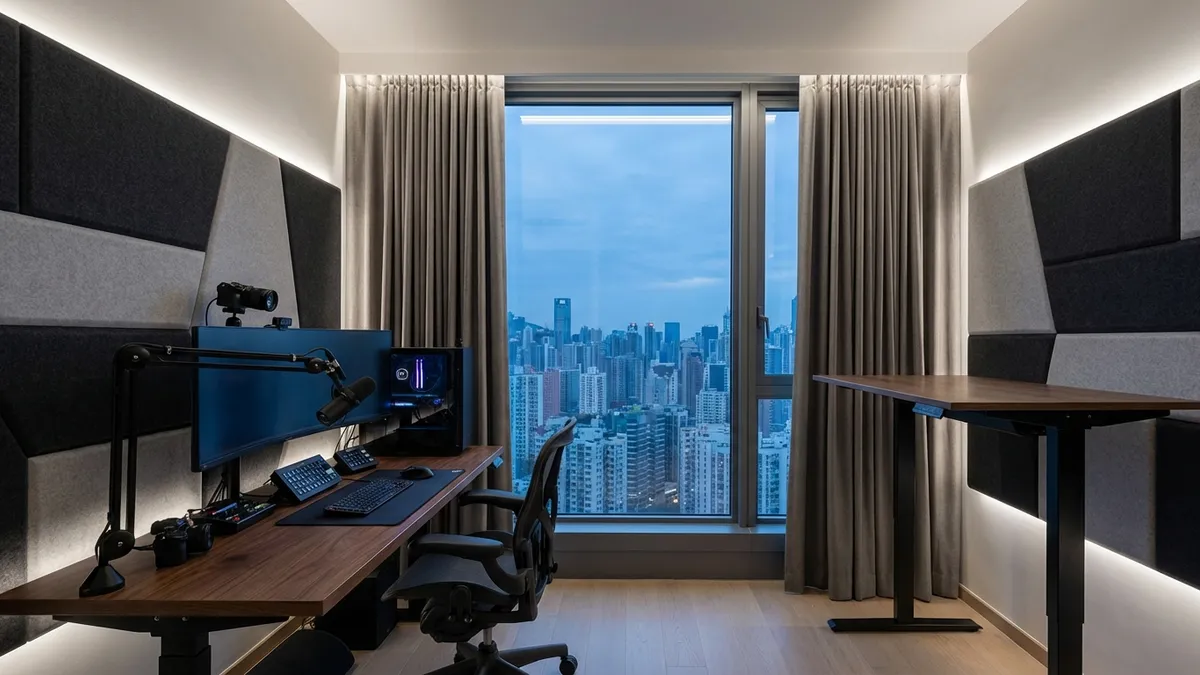
In 2026, where video streaming and content creation have fully matured as professions, choosing a home is no longer just about a “place to live” ; it is about “Selecting a Professional Studio that Generates Profit.”
To be direct, taking labels like “Instruments Allowed” or “Streaming Negotiable” at face value leads to the risk of being forced into “Activity Suspension” due to sound leakage trouble or poor audio quality after moving in.
In this article, we present “Fail-Proof Requirements” for streamers based on physical laws.
Why “Instrument Allowed” Properties are Insufficient for Streamers
Most “Instrument Allowed” properties assume piano practice (primarily during the day until around 8:00 PM). They do not necessarily guarantee the “Late-Night Long-Duration Vocalization” or “Extremely Low Ambient Noise” that streamers require.
- The Time Restriction Barrier : If the rules state “Practice until 9:00 PM,” high-energy midnight streams or sessions synced to overseas time zones become a risk of contract violation.
- Quality of Ambient Noise : Even if wall isolation is high, an old ventilation fan’s “whoosh” getting picked up by your mic will lower listener satisfaction.
- Fragile Internet Infrastructure : While focused on soundproofing, many forget that old VDSL-style buildings make stable high-bitrate streaming impossible.
The Reality of “D-Value” and Recommended Standards
As indicated by the “Law of Mass” in physics, blocking sound is all about the “Weight (Thickness)” of walls and “Airtightness.” Correctly decoding the “D-value (or Dr-value)” in property details is your strongest defense.
| Isolation Class | Streamer Perceived Level | Recommended Streaming Style |
|---|---|---|
| D-55 to D-60 | Loud commentary is a “faint whisper” next door. | Midnight gaming, chatting, singing. |
| D-50 | Normal speech disappears ; shouting is audible but muffled. | Daytime chatting, calm commentary. |
| D-45 or less | High risk of loud midnight voices leaking through. | Not recommended to avoid noise trouble. |
My professional recommendation is to use “D-55 or higher” as your baseline. If you anticipate high-emotion scenes at midnight, this value directly links to your “Peace of Mind (= Performance Quality).”
The “Streaming-Specific” Checklist for Property Viewings
During a viewing, you must personally check the “Exits and Entrances of Sound” that agents won’t explain.
Soundproof Hoods and Airtightness of Vents
Soundproof properties are highly airtight, making ventilation mandatory. However, check if external noise (sirens or construction) enters through these paths. If possible, check indoor silence with the ventilation fan on “High.”
Climate Capacity for PC Heat
Soundproof rooms trap heat like a thermos. If running a high-spec gaming PC, standard-issue ACs may lack cooling capacity. Check the AC’s manufacturing year and Cooling Power (kW) to ensure it has headroom for the room size.
Reading Between the Lines of the Contract
Carefully check for clauses like “Subwoofers Prohibited” or “Limits on Multiple People in Room” that may hinder your activities. Complaints regarding “Vibration” are increasing in 2026, making pre-contract confirmation essential.
Conclusion : Soundproof Rentals are an Investment in “Time” and “Focus”
For a streamer, soundproofing is the cost of buying “The freedom to express yourself fully 24/7 without hesitation.”
High-isolation brand properties like “Musision” or “Lasikuras” may have high rent, but they are the best solutions to solve “The stress of fearing complaints” and “Studio rental costs” all at once.
Related Articles :