The Truth About STC Ratings: Why Japanese \"Dr-Values\" Are Stricter
Is 'STC 50' enough for your studio? Don't bet your security on a potentially misleading metric. Learn why the Japanese 'Dr-Value (D-Value)' is the gold standard for acoustic precision and how it protects you in ways STC simply can't.
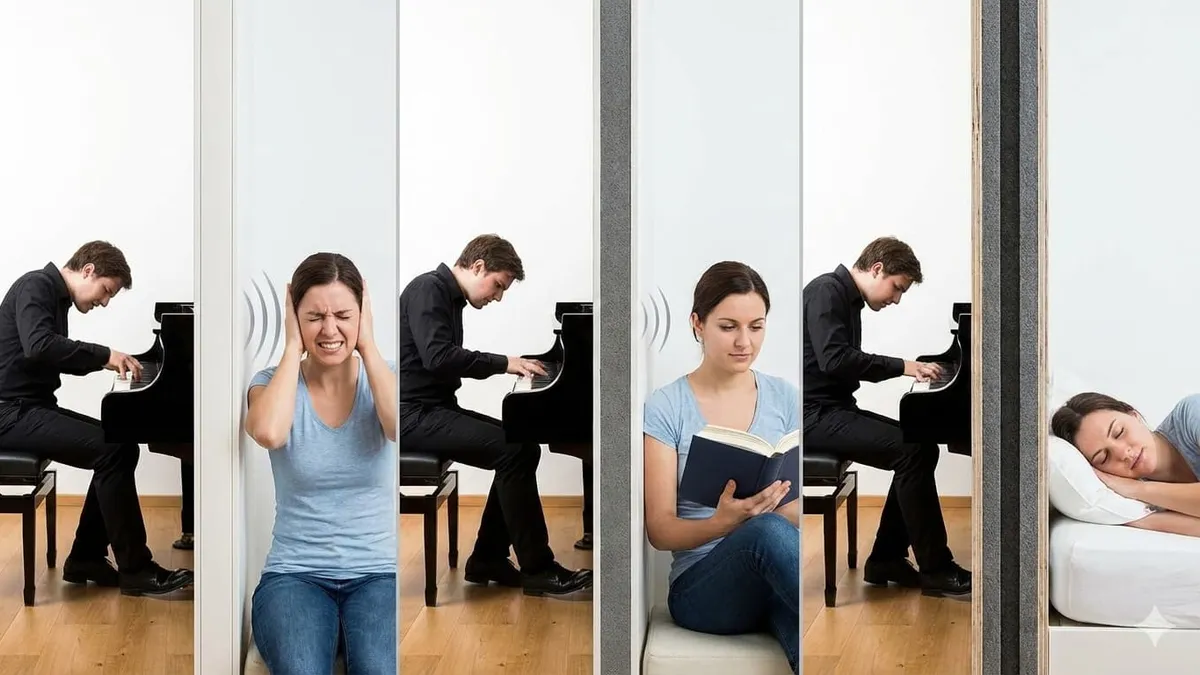
If you browse Western soundproofing sites, the acronym “STC (Sound Transmission Class)” is everywhere. “STC 50 stops piano noise,” they claim. But if you’re serious about your home studio or late-night practice in a high-density apartment, relying solely on STC is a gamble you might lose.
In Japan, where every square inch counts and neighbors are just a thin wall away, we developed a more rigorous, ultra-precise metric: the “Dr-Value” (or D-Value).
Here is why the Tokyo Standard of Dr-Values is the only metric you should trust for guaranteed silence.
1. Benefit: Predictive Silence (No More “Loud Neighbor” Roulette)
The primary benefit of the Dr-Value system is its predictive accuracy. Unlike STC, which can be manipulated by high-frequency performance, Dr-Values give you a direct, actionable calculation:
- Formula: Internal Volume (dB) - Dr-Value = Neighbor’s Level (dB)
If a saxophonist plays at 100dB inside a Dr-40 booth, the sound in the next room is exactly 60dB—the volume of a normal conversation. This direct subtraction works with incredible reliability across the entire frequency spectrum. With STC, you might have “STC 55,” but if it’s weak in low frequencies, your neighbor will still hear your bass thumping through the walls.
2. Evidence: The 125Hz-4kHZ Performance Curve (JIS Standards)
Why is the Dr-Value more reliable? Because it follows the JIS (Japanese Industrial Standards) A-1416, which measures across five critical frequency bands from 125Hz to 4000Hz.
- The Proof: For a product to be rated Dr-40, it must meet the -40dB threshold across every frequency band tested. If it fails at the critical 125Hz low-end, even if it excels at high-end frequencies, it cannot be rated Dr-40.
- The Result: When you see a “Dr” rating from a Japanese manufacturer like Yamaha or Kawai, it is a performance guarantee, not just a lab average.
3. Advantage: Engineered for High-Density Living (The Tokyo Advantage)
The Dr-Value was born in the most noise-sensitive housing market in the world.
- The Cultural Gap: In the US or Europe, large suburban homes allow for some low-frequency “bleed.” But in a Tokyo apartment, even a tiny leak is grounds for an eviction notice.
- Professional Trust: Recording engineers and architects in Japan prefer the Dr-value because it targets the “worst-case scenario” frequencies (like piano bass or vocal resonance) that STC often masks in its averaging.
4. Feature: The “Golden Grid” of Soundproofing Grades
Understanding the grades is your roadmap to choosing the right level of investment.
| Rating | DB Reduction | Best Use Case |
|---|---|---|
| Dr-30 | -30dB | [Standard] Work-from-home, day-time keyboard practice. |
| Dr-35 | -35dB | [Premium] Upright pianos, acoustic guitars, vocal recording. |
| Dr-40 | -40dB | [Professional] Saxophones, trumpet, midnight piano practice. |
Remember, a difference of 5dB isn’t small. In the logarithmic world of decibels, an extra 10dB of isolation means the sound energy is reduced to one-tenth of its original power. Jumping from Dr-30 to Dr-40 is the difference between “hearing the song” and “hearing a faint whisper.”
Summary: Your Reputation Depends on the Right Metric
Don’t let a “high STC number” on a marketing flyer mislead you. If your goal is true acoustic isolation, insist on products tested to the Japanese Dr-Value standard.
Choosing Dr-Values isn’t just about blocking noise; it’s about buying peace of mind and the freedom to create at any hour of the night.
Related Articles: