The Limits and Physical Boundaries of DIY Soundproof Rooms | The Critical Difference from Brand U...
Is it really possible to build a $1,000 soundproof room? We analyze the cold physics of the 'Law of Mass,' the 1% gap failure, and the lethal risks of heat and CO2 in DIY spaces.
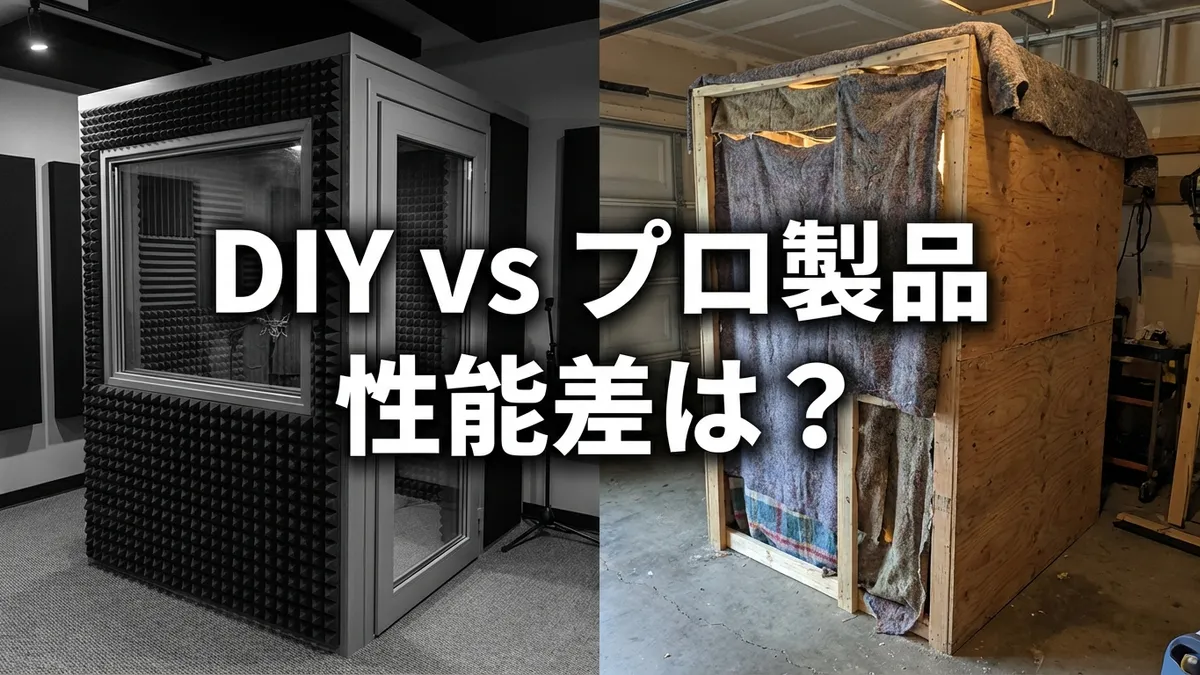
“Manufacturer units are too expensive, so I’ll just DIY it to save money.” This hope, held by many, is often crushed by the cold physical laws of “The Law of Mass” and “Airtightness.”
To be frank, most DIY soundproof rooms struggle to exceed the level of a “slightly quiet storage shed.” To reach a level where you can play instruments in an apartment (Dr-35 or higher), you need material costs and engineering knowledge comparable to professional products.
In this article, we present the realistic boundaries of DIY without dismissing the “romance” of building—to ensure you don’t end up creating “giant oversized trash.”
Conclusion : DIY Rooms Often Fail to Become More Than “Quiet Storage”
Soundproofing performance is determined by simple physical facts, not the brand of materials.
- Lack of Physical Mass : The power to stop sound is proportional to the “Weight (Surface Density)” of the walls. Compared to professional units weighing hundreds of kilograms, a DIY room made of thin wood and soundproof sheets physically abandons low-frequency isolation from the start.
- Limits of Airtightness : In soundproofing, there is a golden rule : “A 1% gap reduces isolation performance by 10-20dB.” The hardest parts to DIY are the “Soundproof Door” and its sealing. This becomes the bottleneck, dragging the overall performance down to Dr-25 (where voices are only slightly muffled).
Physical Defeat : The Walls of “The Law of Mass” and “Airtightness”
DIY builders most often overlook resistance to low frequencies.
- Low Frequencies Cannot be Stopped : No matter how much light “Absorber” (foam or felt) you stick on, low-frequency energy passes right through. Blocking bass or deep male voices requires “Weight” (multiple layers of gypsum board), and the frame strength required to support that weight often exceeds DIY categories.
- The Sound Leak Tunnel : Ventilation holes, wiring, and door gaskets. If the treatment of even one of these is poor, sound will bypass the walls, no matter how high their individual performance is.
Overlooked Survival Risks : “Ventilation Failure” and “Thermal Runaway”
In summer, locking yourself in a high-insulation box is literally life-threatening.
Rapid Spike in CO2 Concentration
In a high-airtightness 1-tatami (1.5sqm) DIY booth, CO2 levels spike in minutes, leading to loss of focus or headaches. However, simply opening a hole makes it a “Sound Exit.” Designing a “Silencer Duct (S-curve structure)” that moves air while maintaining performance is extremely difficult for amateurs.
Heat Accumulation
PCs, monitors, lighting, and body heat. This heat has nowhere to go in a space surrounded by insulation. A DIY room that cannot support an AC unit essentially becomes a “Usable Only for Minutes Sauna” in summer.
Financial Disconnect : Disposal Debt vs. Asset Value
From a long-term cost perspective, DIY is not always “cheap.”
Zero Resale Value
Yamaha or Kawai rooms have established value in the second-hand market and can be sold at high prices even after years of use. In contrast, a DIY structure has zero value when moving—it becomes a “Liability” requiring thousands of dollars in “Construction Waste Disposal Fees” for demolition.
Loss of Opportunity Cost
Consider the risk of spending months of weekends building something that fails to perform. If you had used that time for practice or creation, what value would you have generated? This “Opportunity Cost” must be considered.
Summary : DIY is the Right Choice if You Seek “Freedom,” Not “Cheapness”
If you still choose DIY, you must clarify your goals :
- Limit use to vocal recording/narration and do not expect low-frequency isolation.
- Start with “Danbocchi” or simple kits and customize them with absorbers.
- Ask yourself if you value the “process of building” more than the performance.
If what you seek is a “Professional-grade Production Environment” or “Absolute Avoidance of Neighbor Trouble,” buying a used brand unit with a loan will result in lower lifetime costs and higher happiness.
Respect the laws of physics and set realistic goals. That is the first step to a wise soundproof life.
Related Articles :