2025 Acoustic Tech Trends: How AI, Metamaterials, and Sustainability are Redefining 'Silence'
The era of 'Thick and Heavy' soundproofing is over. In 2025, acoustic technology has evolved into active cancellation with AI, miracle 'Metamaterials,' and specialized solutions for the EV era. Explore the top 5 trends transforming the industry.
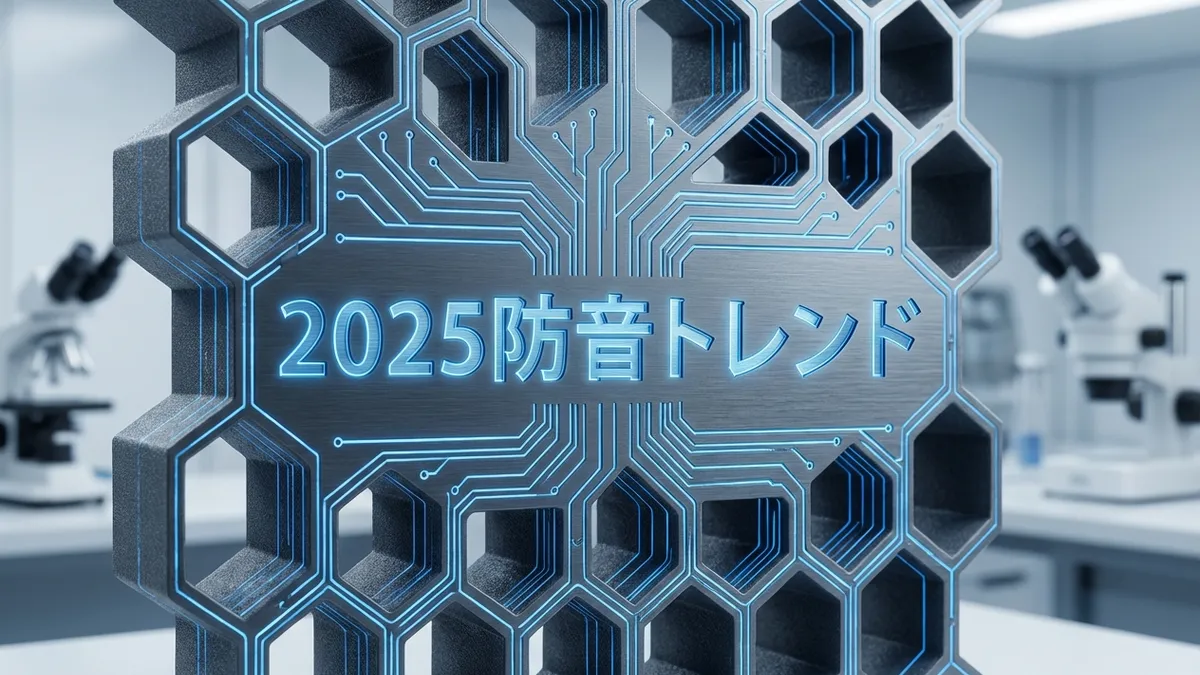
2025: From “Raw Mass” to “Intelligent Design”
Traditionally, the standard for soundproofing was “The heavier the wall, the better the silence.” However, 2025 marks the point where that wisdom has become obsolete.
According to latest market research, the Japanese soundproofing market has reached ¥55 Billion annually, with the Creator segment (YouTubers/VTubers) growing by 30% year-on-year. This rapid expansion is powered by a paradigm shift toward “Smart, Eco-friendly, and High-efficiency” soundproofing technology.
Here are the 5 Hot Topics defining the acoustic landscape of 2025.
The 5 Tech Trends Leading 2025
1. Evolution of AI-Driven “Personalized ANC”
Active Noise Cancellation (ANC), which started in headphones, is now being applied to entire environments. AI analyzes surrounding sounds—office chatter, train rumbles—in real-time and automatically applies the optimal phase-reversal pattern tailored to the user’s behavioral history. We have entered the era where AI crafts a “Bespoke Silence” just for you.
2. Commercialization of “Acoustic Metamaterials”
“Acoustic Metamaterials”—engineered materials with structures not found in nature—have entered the mass-market phase. While blocking low-frequency noise previously required massive physical weight, these materials achieve identical performance with 1/4 of the weight. Leading Japanese companies like Daiken Corporation have established dedicated R&D hubs (e.g., “Oto Lab”) to accelerate the integration of these materials into residential buildings.
3. Acoustic Engineering for the EV (Electric Vehicle) Shift
The global shift to EVs has revolutionized acoustic insulation requirements. With engine noise gone, road noise and motor hum have become the main targets for isolation. New absorption technologies focused on these specific frequency ranges—such as urethane-based lightweight panels—are now being adapted from the automotive sector to residential home offices.
4. “Sustainable” and “Multi-Functional” Materials
Driven by environmental consciousness, biomass-based soundproof materials using recycled polyester and natural fibers (Kenaf, wood fiber) are becoming the industry standard. Innovation has also led to “High-Function Composites” that combine Absorption, Insulation, Seismic Safety, and Heat Insulation into a single, lightweight panel, drastically lowering the barrier for installation in rental apartments.
5. “Smart Design” through IoT and Digital Simulation
The integration of BIM (Building Information Modeling) and acoustic analysis software allows for 100% scientific simulation during the design phase. IoT sensors placed within a room can monitor the acoustic environment in real-time, providing cloud-based consulting services that suggest adjustments to maintain the perfect recording or work environment.
Market Snapshot: 2024–2030 Forecast
| Category | 2024 Actual | 2025 Estimate | 2030 Forecast |
|---|---|---|---|
| Market Size (JP) | ¥50.0B | ¥55.0B | ¥120.0B |
| Tech Adoption | < 5% | 10% | 40%+ |
| Growth Driver | Streamers | AI/Materials | Smart Cities |
Conclusion: Investing in “Experience,” Not Just Gear
In 2025, soundproofing has transcended the passive role of “blocking noise” and has become an active, intelligent service that creates the “Ultimate Acoustic Space” automatically.
When considering a soundproof booth or renovation, don’t just look at decibel ratings. Check if the system is “Smart-Ready” and utilizes sustainable, next-gen materials. Ideal silence is no longer a luxury; it is the essential infrastructure required to unlock your focus and creativity in the digital era.