Soundproof Room Ventilation and Silencer Design | Solving the Trade-off with Lossnay
'Ventilation leaks sound, but sealing is life-threatening.' We explain the ultimate dilemma of balancing air and isolation. Learn why Mitsubishi's 'Lossnay' is standard and how to manage NC values for recording quality.
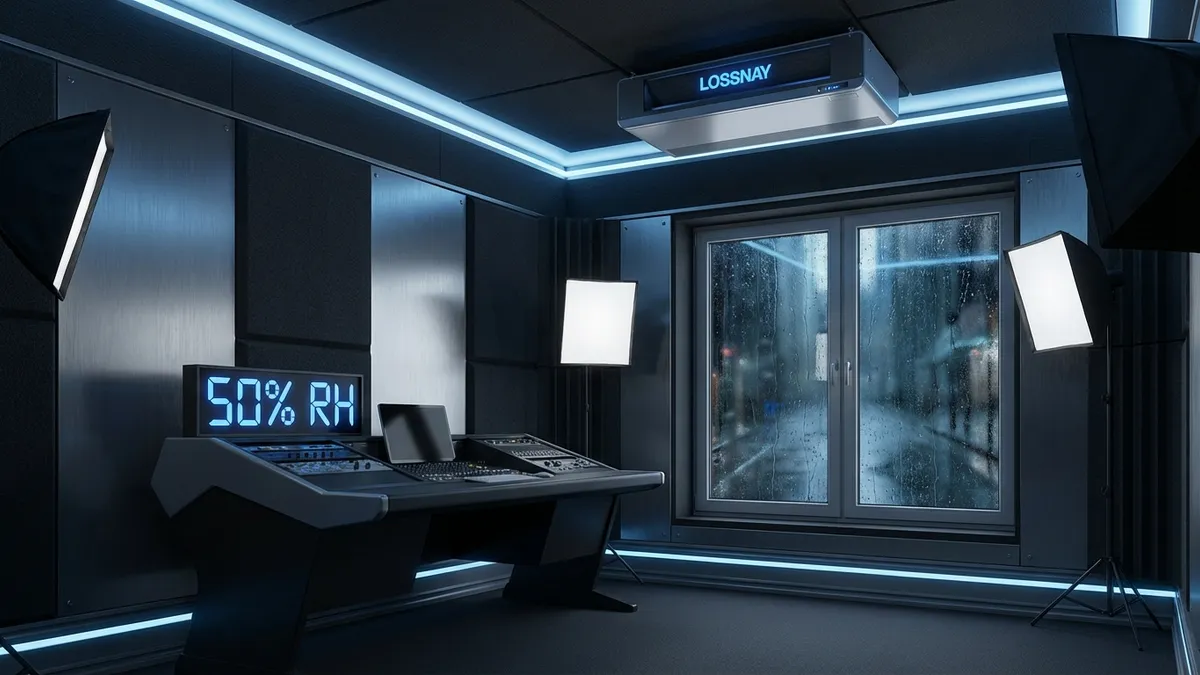
In soundproof room design, “Ventilation” and “Sound Isolation” are in a physically opposing trade-off.
To exchange air, you need holes (openings) in the wall, but those holes are the easiest escape routes for sound. However, in a sealed space of about 1-tatami (1.5sqm), the CO2 concentration from an adult male will rise to levels that impair focus in just 15 minutes.
In this article, we explain the “Silenced Ventilation System” and the reality of Lossnay required to balance silence and oxygen.
Conclusion : Vents are “Sound Escape Routes” and Carry Full Responsibility
No matter how high the wall’s D-value is, if the ventilation treatment is weak, all sound will leak through. The basic strategy to prevent this is “Sound Attenuation.”
- Chamber Structure : By making the ventilation path zigzag and lining the interior with absorbers, you attenuate sound energy against the walls while letting air through (maze structure).
- Duct Silencing : You must stop both fan noise and internal sound leakage simultaneously. In cheap booths, the “Air Intake/Exhaust” is where most leakage occurs.
The Magic of Lossnay : Oxygen Without Sound Leakage
The “Lossnay” (by Mitsubishi Electric) , standard in major rooms like Yamaha or Kawai, is a life-support system for soundproof rooms.
- Merits of Heat Exchange : It swaps cold winter air or hot summer air with the heat of the exhausting air. This provides fresh oxygen while preventing rapid room temperature changes.
- Isolation via Barriers : Inside a Lossnay, air and sound are managed through a special paper element (Lossnay Element), blocking a direct “Air Path.” This is the physical basis for its high sound isolation.
The Challenge of NC Values : Silent Ventilation Defines Recording Quality
For recording engineers, what matters is not just isolation, but “How quiet the room is (NC Value).”
- Reducing Airflow Noise : If the fan speed is too high, a “whooshing” wind noise occurs at the vent, which condenser mics will pick up.
- Improving S/N Ratio : A quiet ventilation system ensures a high Signal-to-Noise (S/N) ratio, allowing you to capture minute details. When selecting a Lossnay, choose a size that provides sufficient ventilation even at “Low” speed.
AC Installation Pitfalls : Preventing Leakage via Pipes
AC is also mandatory for heat, but there is a trap here as well.
- Pipe Sleeve Gaps : Fill the hole for refrigerant pipes with an excessive amount of “Soundproof Putty.” A tiny gap will cause D-50 performance to crumble.
- Drain Hose Backflow Noise : External noise (traffic) can enter through the drainage hose. Installing a check valve is an essential detail for a professional environment.
Conclusion : A Soundproof Room is Complete Only with Silence and Oxygen
Environmental measures are as important as isolation performance—they define “Sustainable Use.”
- Design based on the premise of “Being able to breathe” (Lossnay recommended).
- Always install a silencer chamber on vents (block the direct path of sound).
- Ensure absolute airtightness of AC pipe sleeves.
What you need for your best performance is not just silence, but a “Cool, oxygen-rich, and quiet space.” When these three elements align, your soundproof room becomes a true creative sanctuary.
Related Articles :